What is Closed Loop Medication Management?
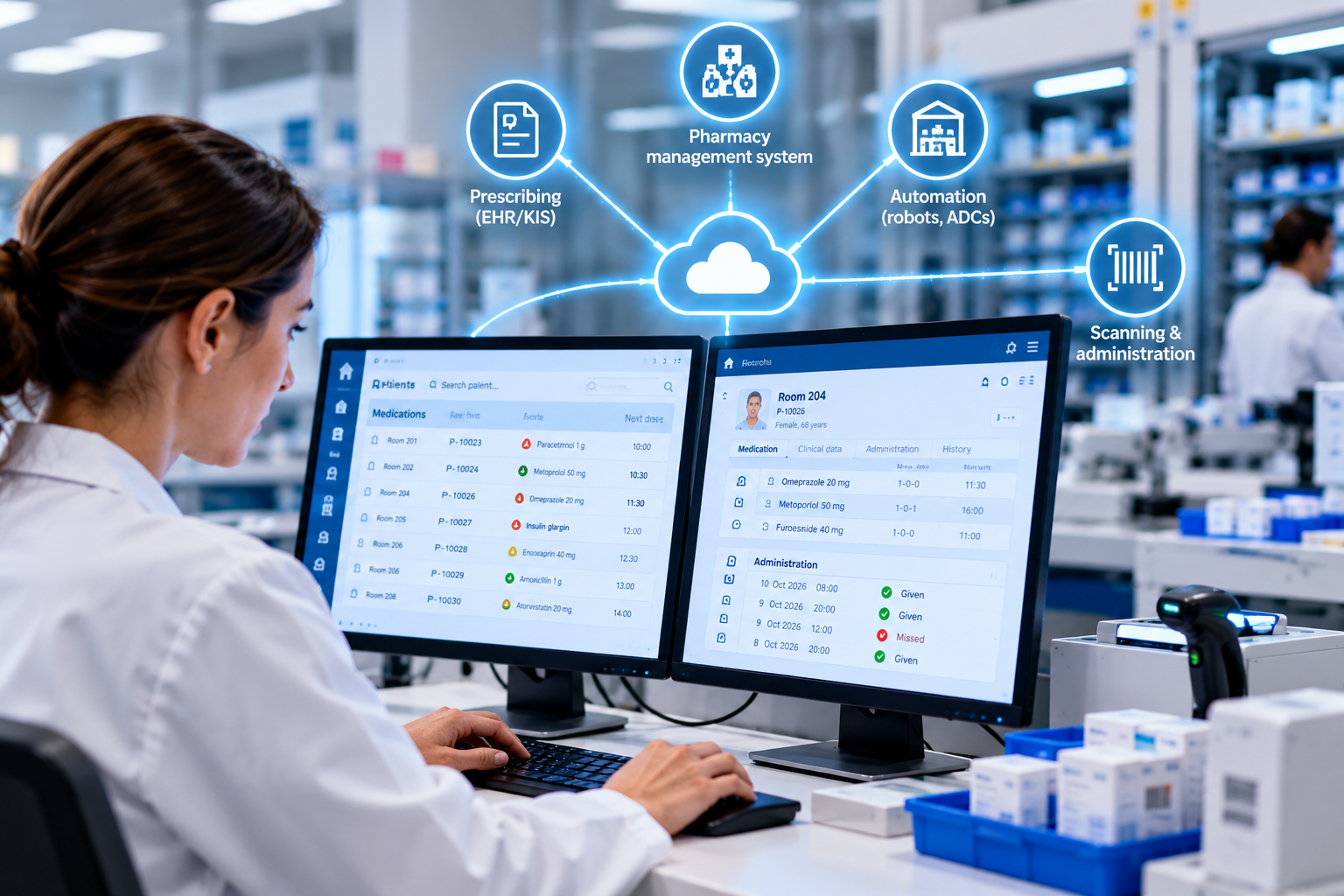
Closed Loop Medication Management (CLMM) is an integrated approach to medication management in hospitals that connects the entire medication process — from prescribing and pharmaceutical verification to dispensing, administration and monitoring.
The aim is to create a closed and traceable medication loop in which the right patient receives the right medication, in the right dose and formulation, at the right time and through the right route. Digitalisation, automation and barcode identification can support these safeguards, but technology alone does not create a closed loop.
Effective Closed Loop Medication Management requires the integration of people, processes, technology and data across the hospital. This typically involves the electronic prescribing system or EHR, pharmacy information systems, Unit Dose dispensing, Automated Dispensing Cabinets, barcode medication administration and reliable interoperability between these systems.
For GPP Support, CLMM is therefore not primarily an automation project. It is a hospital-wide transformation of the medication process, with medication safety, efficiency and sustainable implementation at its core.
From Closed Loop vision to implementation
Implementing Closed Loop Medication Management requires more than selecting technology. It starts with understanding the current medication process, defining the future operating model and determining how people, processes, technology and data need to work together.
GPP Support provides independent, vendor-neutral support to hospitals from strategy and business case to technology selection, procurement, implementation and sustainable change.
Our support can include:
- CLMM strategy & roadmap — defining the future medication process and transformation path.
- Business case & value assessment — evaluating investment, safety, workforce and operational impact.
- Technology assessment — independently evaluating Unit Dose, Automated Dispensing Cabinets, robotics and barcode solutions.
- Tendering & procurement — translating the target model into requirements and supporting vendor-neutral selection.
- Implementation & programme management — connecting pharmacy, nursing, medical staff, IT, hospital management and suppliers.
- Change & adoption — embedding new workflows and technologies in daily practice.
The appropriate Closed Loop architecture is not the same for every hospital. Centralised, decentralised and hybrid medication-management models each have strengths and limitations. The challenge is to design the model that best fits the hospital’s clinical processes, organisation, digital infrastructure and strategic ambitions.

Building the Closed Loop
Closed Loop Medication Management connects clinical, pharmaceutical and logistical processes into one integrated and traceable medication pathway.
Key elements typically include:
- Prescribing & pharmaceutical verification — creating structured medication orders and enabling clinical assessment by the pharmacy.
- Pharmacy automation & Unit Dose — supporting accurate, patient-specific dispensing and identification of individual medication units.
- Decentralised dispensing & bedside verification — using solutions such as Automated Dispensing Cabinets and barcode medication administration to support safe and traceable medication use closer to the patient.
- Interoperability & data — connecting EHR, pharmacy, automation and bedside systems so that information moves reliably through the medication pathway.
- Monitoring & continuous improvement — using process and outcome data to identify risks and improve performance.
Having these components does not automatically create a closed loop. The real value emerges when technology, workflows, responsibilities and data are designed as one end-to-end medication process, supported by clear governance and interdisciplinary collaboration.
Creating value with Closed Loop Medication Management
Closed Loop Medication Management can create value far beyond the pharmacy. When medication processes, technology and data are effectively integrated, potential benefits include:
- Medication safety — reducing opportunities for medication errors through standardisation, traceability and verification.
- Workforce efficiency — reducing manual and repetitive activities and freeing professional time for higher-value tasks.
- Operational efficiency — improving medication logistics, inventory management and medication availability.
- Traceability & data — providing better insight into medication flows, administration and process performance.
- Economic value — combining safety, workforce, inventory and process benefits into a sustainable business case.
These benefits do not arise from technology alone. Their realisation depends on process redesign, integration, adoption and continuous performance management. GPP Support therefore approaches the CLMM business case as an assessment of value across safety, workforce, operations and investment.
Closed Loop Medication Management in practice
GPP Support combines more than 30 years of experience in hospital pharmacy and medication logistics with practical involvement in Closed Loop Medication Management projects across Europe.
Our work is complemented by international knowledge exchange through The Asclepius Project, an independent European network exploring medication safety, digitalisation, automation and the transformation of hospital medication processes.
This combination of project experience, international collaboration and evidence-based knowledge helps translate Closed Loop Medication Management from a concept into solutions that work in real hospital practice.