Transforming Medication Management in European Hospitals
GPP Support is an independent consultancy specialising in hospital pharmacy strategy, Closed Loop Medication Management, automation and digital transformation — from vision and business case to implementation and sustainable change.
Our expertise
We help hospitals translate strategy and technology into safer, more efficient and future-ready medication management.
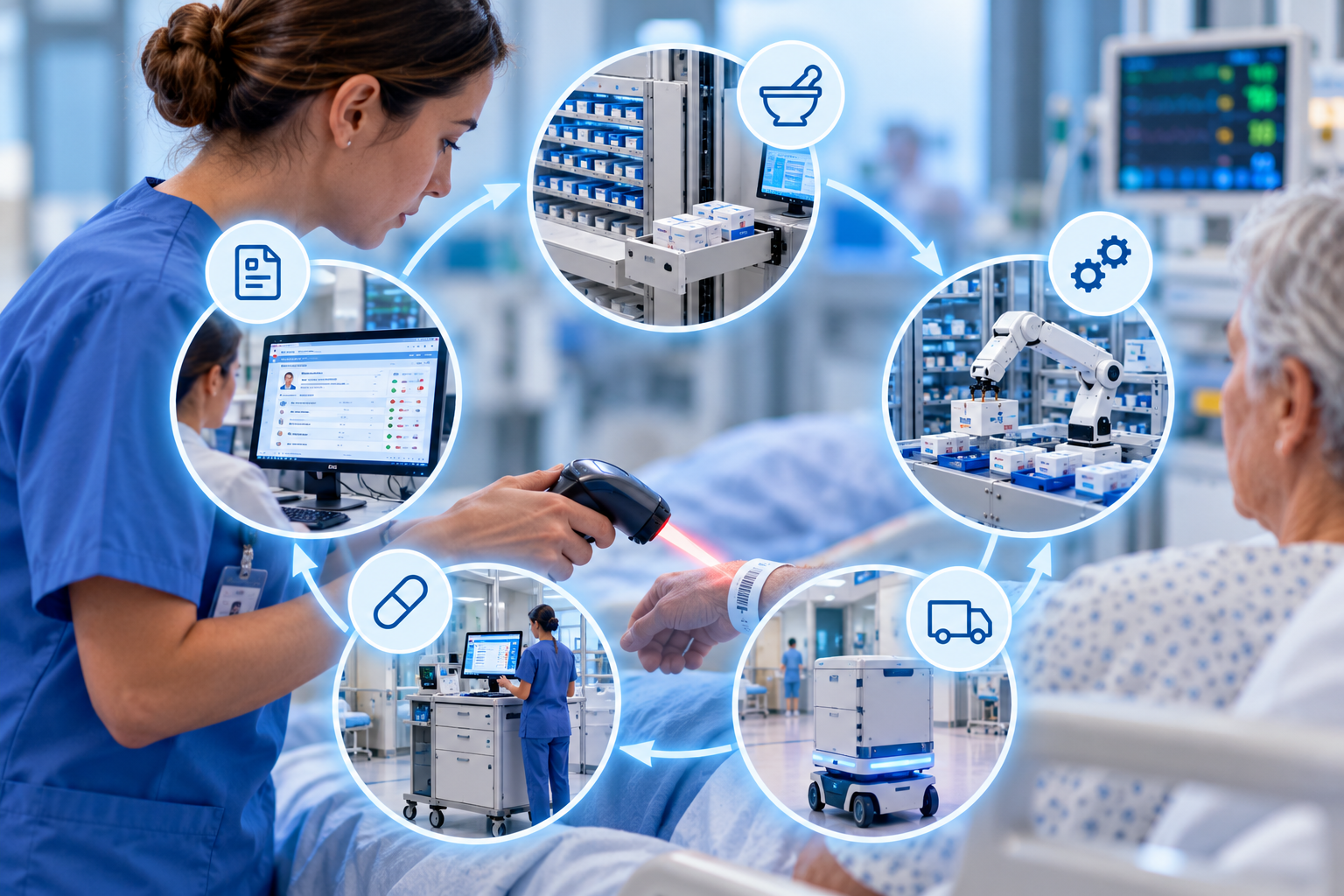
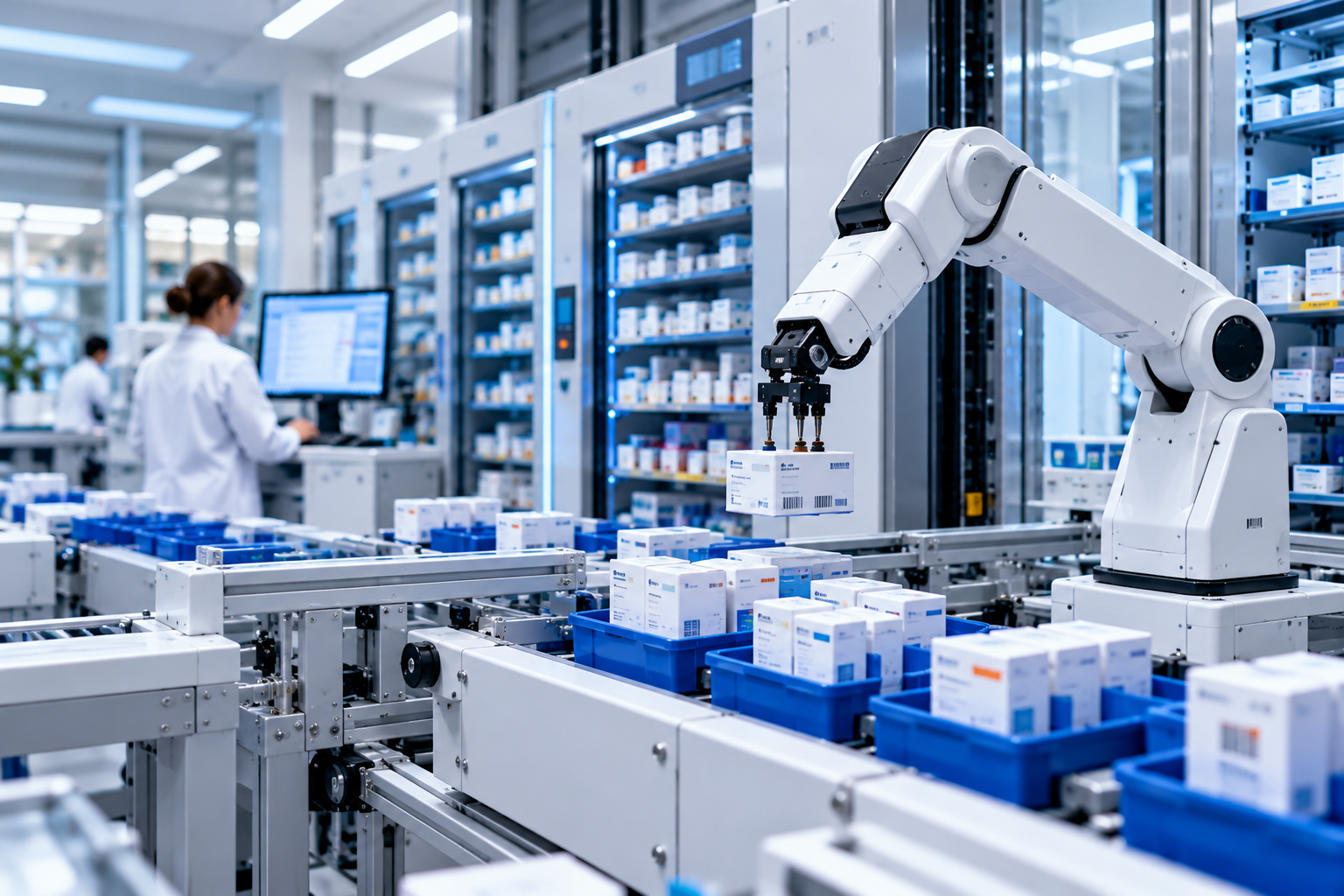
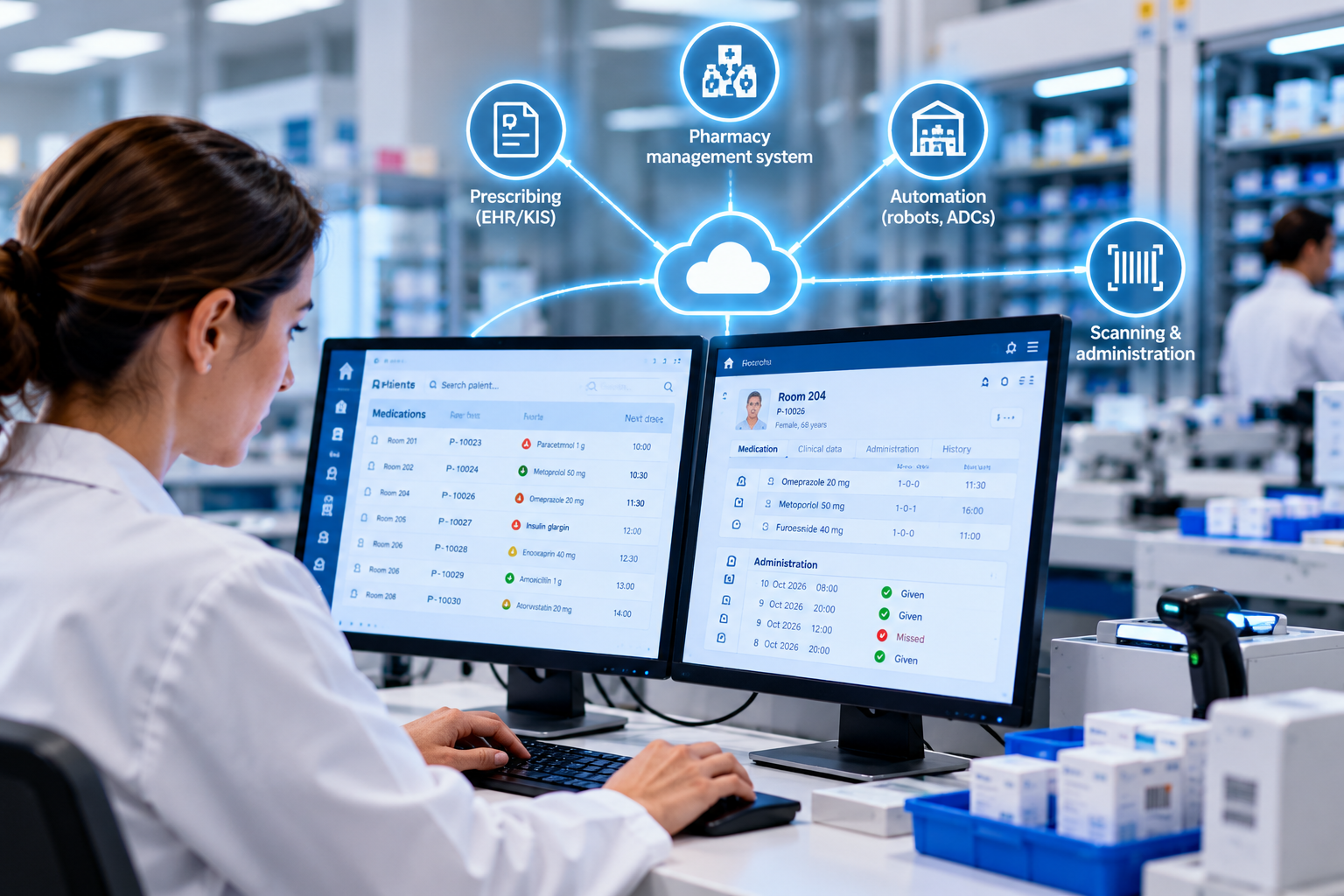
I help organisations and teams to make the right choices and transform ideas into reality.
Read moreAbout GPP Support
GPP Support is an independent consultancy specialising in hospital pharmacy strategy and the transformation of medication management in European hospitals.
With over 30 years of experience in hospital pharmacy, Patrick van Oirschot combines strategic insight with hands-on expertise in Closed Loop Medication Management, automation, digitalisation and organisational change.
Working closely with hospital pharmacists, healthcare management and technology partners, GPP Support helps translate complex challenges into practical solutions — from developing a strategy and building a business case to selecting technologies and managing implementation.
Medication safety is at the heart of everything we do. We believe that sustainable improvements in medication management require more than technology alone. They depend on well-designed processes, engaged healthcare professionals and effective collaboration across disciplines.
Our approach combines an independent perspective with practical experience and a strong European network. We help hospitals navigate complex transformations, ensuring that innovation delivers measurable improvements in patient safety, operational efficiency and the use of healthcare professionals’ valuable time.
Our latest posts
We believe in making medication services safer in an organisation that is geared to its task and knows where it is going. Keep up to date with us.

Driving valuable change in pharmaceutical care – Closed Loop Medication Management Expert
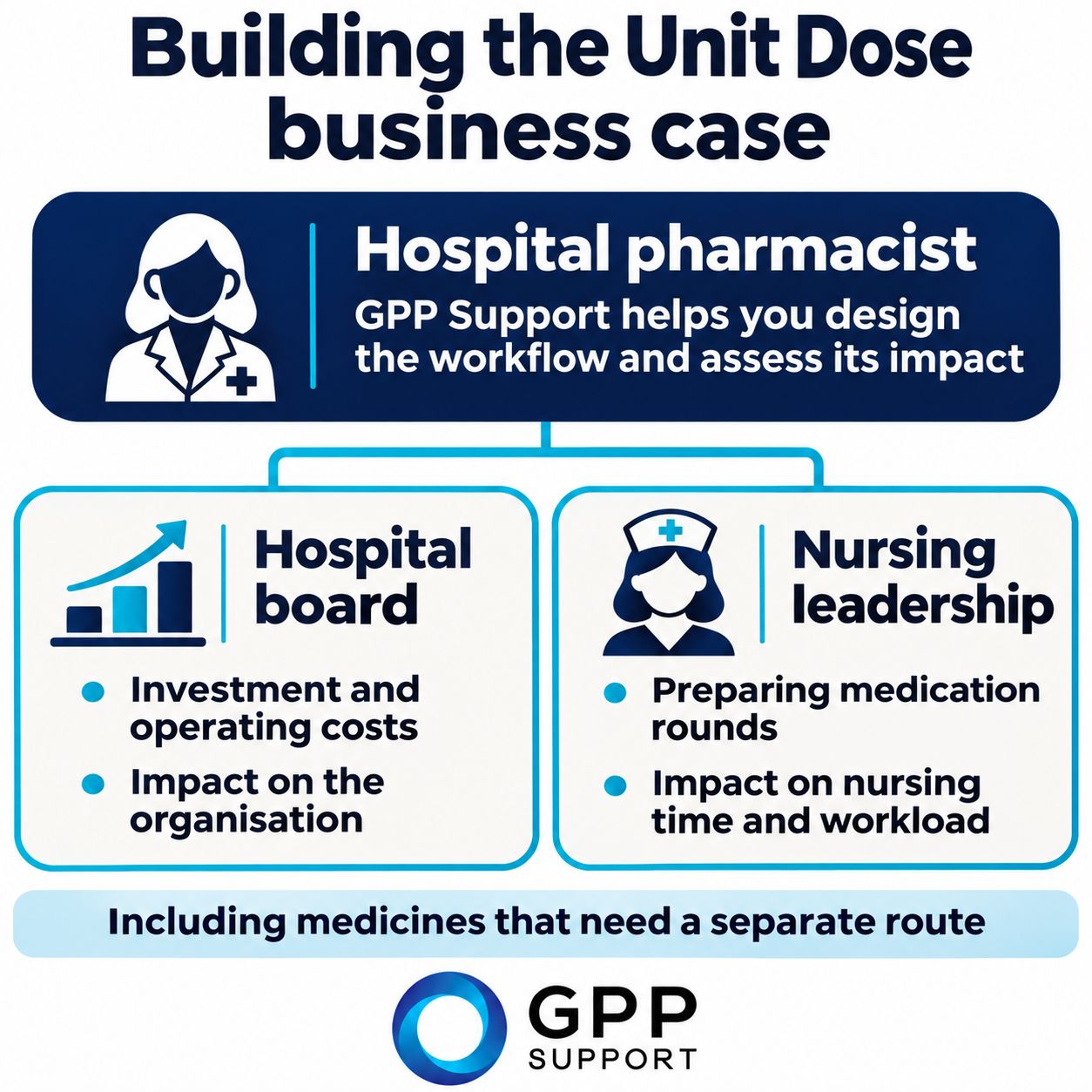
You’ll need to answer two questions. Your board will want to know what the investment means for operating costs. Your nursing colleagues will want to know what it means for their next medication round.
Both questions start with the same thing: how will nurses prepare that round once the system is in place?
Imagine a patient whose tablets are supplied as unit doses and who also needs a refrigerated medicine. Where does the nurse collect it? How does it come together with the unit doses? How does the nurse check that the round is complete?
Work through those steps with your nursing colleagues and you can see which tasks disappear, which remain and which move to the pharmacy. That gives you a basis for estimating how much time nursing can free up, what extra capacity the pharmacy might need and where operating costs actually change.
This is where I can support you. I work with you and your nursing colleagues to design the workflow for the full medication round, including medicines that need a separate route. We then translate that workflow into a business case that shows the board what the hospital is investing in and gives nurses a clear picture of how their work will change.
Are you preparing a unit-dose business case for your board? Send me a LinkedIn message and tell me which part of the medication round you’re still working through with your nursing colleagues. We can start there and look at what it means for nursing workload, pharmacy capacity and operating costs.
Driving valuable change in pharmaceutical care – Closed Loop Medication Management Expert
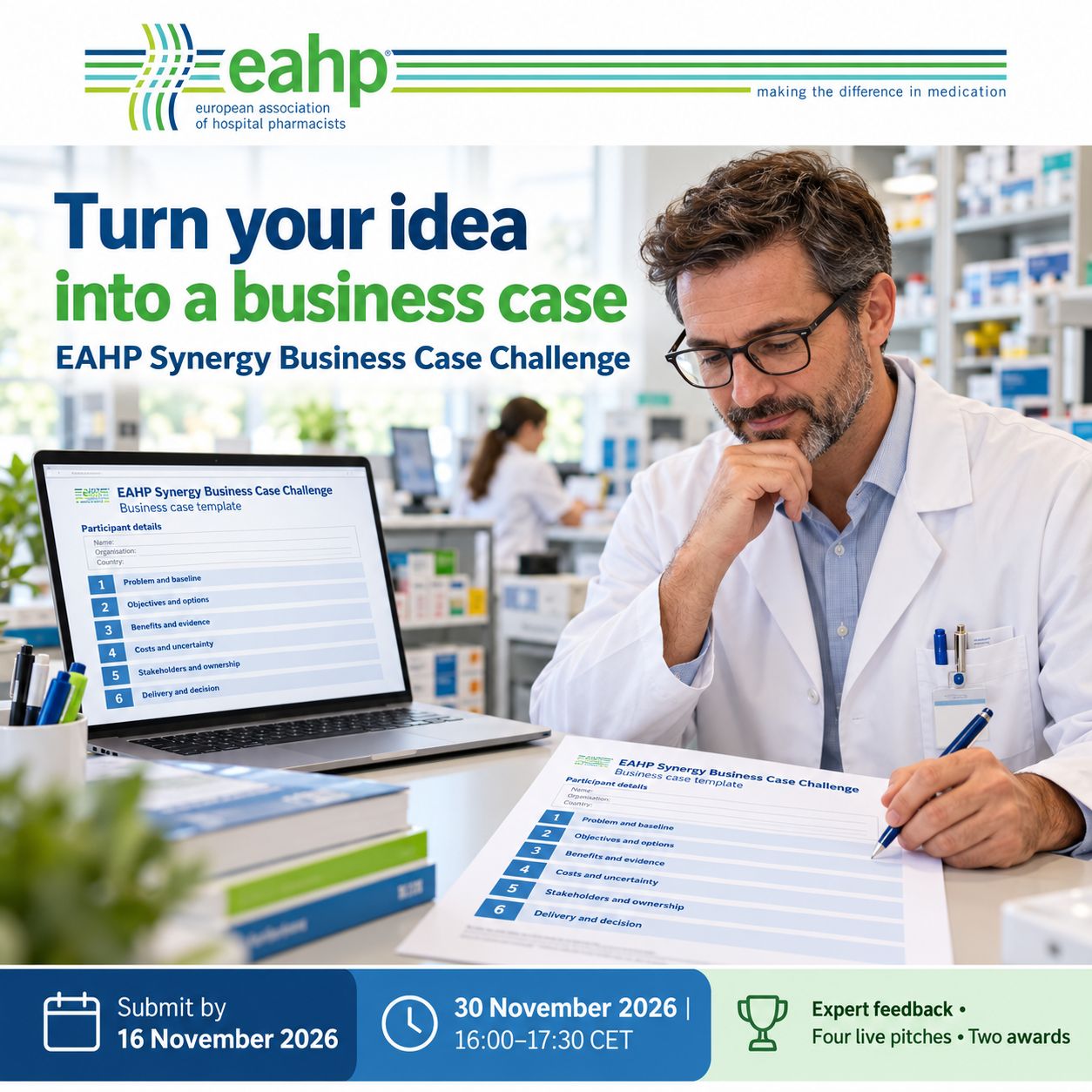
After exploring business case development in our first EAHP Synergy webinar, we now invite you to bring your own hospital challenge to the EAHP Synergy Business Case Challenge.
Together with Jaime Poquet Jornet, Pierrick Bedouch and Francine de Stoppelaar, I look forward to discussing your ideas for digital transformation, automation or Closed Loop Medication Management.
Your proposal can still be at an early stage. You don’t need a complete investment plan or detailed ROI calculation. The submission template will help you explain the problem, consider your options and identify what you need to establish next.
📝 Targeted feedback: the first 20 complete, eligible cases accepted for assessment will receive one key strength, one area for improvement and one recommended next step — whether or not selected to pitch.
🎤 Live discussion: four participants will present their cases during the webinar and discuss them with the faculty and their peers.
🏆 Two awards, each with a prize:
• Jury Award: complimentary registration for the EAHP Congress 2027 in Vienna.
• Audience Choice Award: complimentary registration for EAHP BOOST 2027.
📄 Submission deadline: 16 November 2026
🗓️ Webinar: 30 November 2026 | 16:00–17:30 CET
Join us to pitch — or to learn, ask questions and vote for your favourite. Assessment places are limited to 20 cases, so submit early.
🔗 Registration and participation details:
https://lnkd.in/e2f4zMC4
🎥 Didn’t attend Webinar 1? You’re welcome too. Catch up with the recording and presentations:
https://lnkd.in/er2K2Pbk
Bring a challenge from your hospital. Leave with a clearer next step towards a stronger proposal.
#EAHP #EAHPSynergy #HospitalPharmacy #MedicationManagement #DigitalTransformation
Driving valuable change in pharmaceutical care – Closed Loop Medication Management Expert
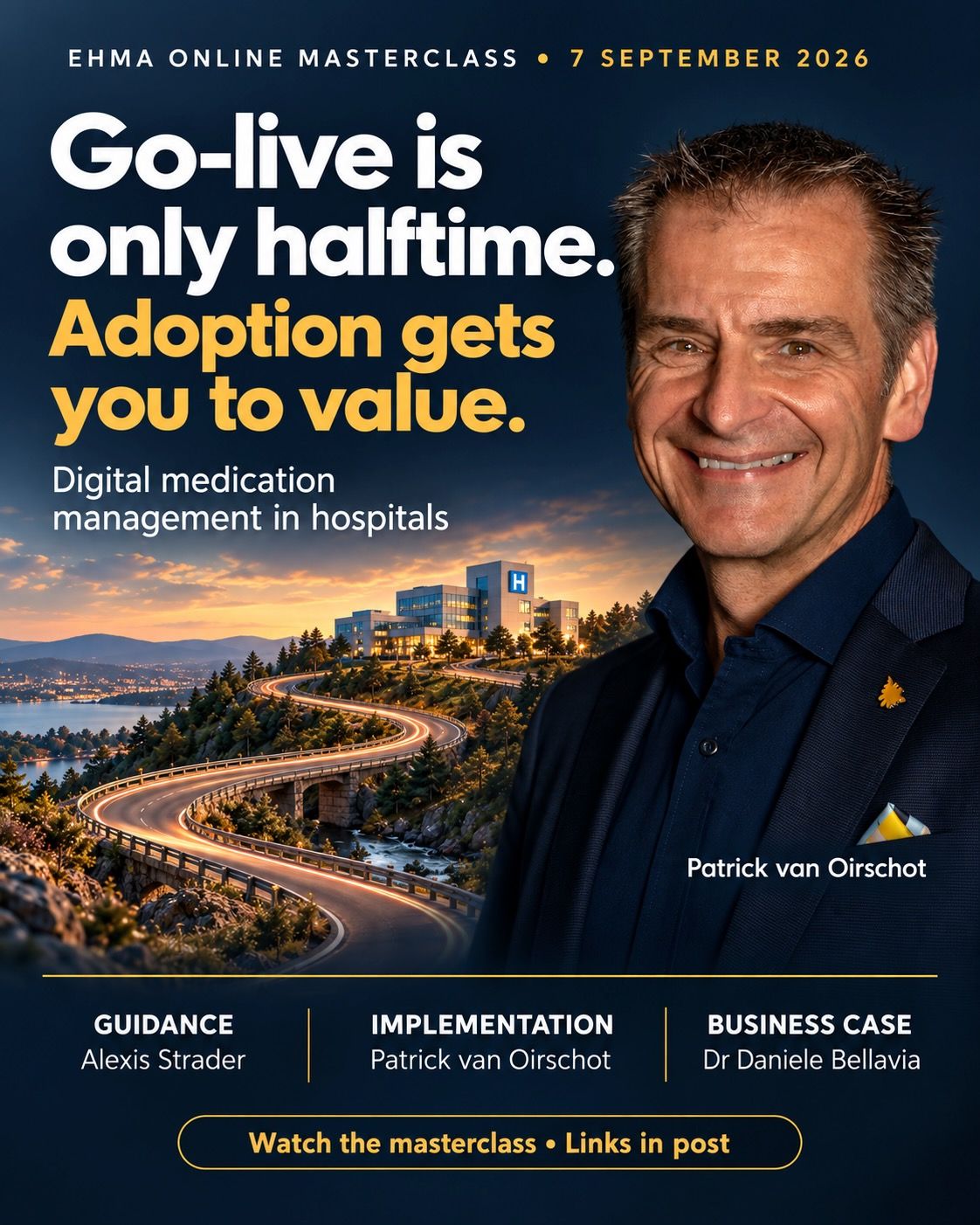
EHMA – European Health Management Association masterclass brought together three perspectives on digital medication management: practical guidance, implementation experience and the business case.
Three messages stood out:
💡 Alexis Strader: Digital medication management is essential hospital infrastructure.
Alexis connected EHMA’s White Paper and Managers’ Guide to practical action: identifying priorities, assessing readiness and bringing the right people together to move implementation forward.
💡 Patrick van Oirschot: Installed ≠ Used ≠ Value.
In my contribution, I explored what happens when plans meet hospital reality. Scope evolves, stakeholders change and technology moves on. Clear ownership, thoughtful workflow design and sustained attention to adoption are what turn implementation into measurable value.
💡 Daniele Bellavia: The purchase price is only part of the investment story.
Daniele explored the economic case for automation, looking beyond acquisition costs to the potential value of fewer medication errors, reduced waste and staff time released. His message: assess the impact on the whole process over time.
Together, these perspectives raise an important question: how do you turn the ambition for safer, more efficient medication management into results in your hospital?
📖 Explore the EHMA masterclass: https://lnkd.in/eRTAiw8G
▶️ Watch the full recording on YouTube: https://lnkd.in/eH7XruZ4
A special thank you to Federica Margheri for moderating the masterclass and guiding the discussion from practical implementation to measurable value and to Sofia Komissarova for all her work behind the scenes to bring everything together.
Would you like to know more about Closed-Loop Medication Management (CLMM), develop a practical implementation approach or build a compelling business case? Follow The Asclepius Project and send me a message. I’d be happy to discuss your challenges and explore the next steps together.
#CLMM #MedicationSafety #DigitalHealth #HospitalPharmacy #EHMA
Driving valuable change in pharmaceutical care – Closed Loop Medication Management Expert
Driving valuable change in pharmaceutical care – Closed Loop Medication Management Expert
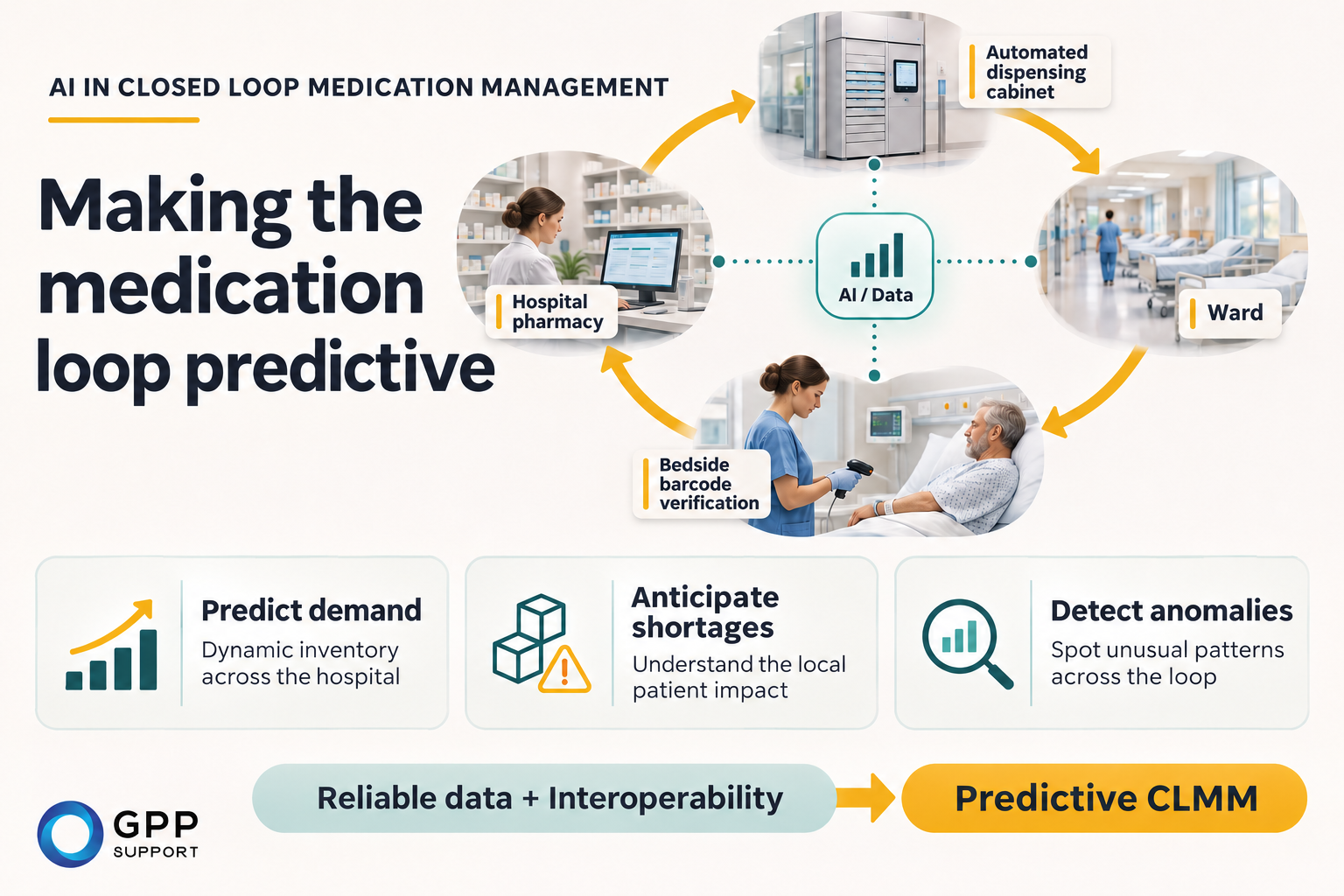
An interesting interview with Michael Palone caught my attention. His central message is simple but important: before getting excited about AI, hospital pharmacies need to get the data right. Looking at this from my work on medication management and CLMM, I see several very practical opportunities. Three stand out to me:
1️⃣ From static to predictive inventory management
Medication inventories are still largely managed through predefined min/max levels and historical data. But modern hospitals have complex networks of central and decentralised stock: hospital pharmacy, ward stock, ADCs, emergency stock and patient-specific medication.
Demand is dynamic. Our inventory systems mostly aren’t.
AI could continuously combine consumption, prescribing patterns, stock movements and operational data to predict where medication will actually be needed — and dynamically optimise inventory across the hospital.
2️⃣ From shortage alerts to predicting impact
Knowing that a medicine may become unavailable is useful. Knowing when that shortage will start affecting your patients and medication processes is much more valuable.
Combining external shortage information with changing prescribing and consumption patterns could help pharmacies anticipate the local impact — including increased demand for alternatives.
3️⃣ From monitoring KPIs to detecting anomalies in the medication loop
CLMM creates thousands of data points every day: dispensing transactions, ADC overrides, stock corrections, returns, barcode mismatches, medication changes and doses dispensed but not administered.
Today, we mainly use these data retrospectively. AI creates the possibility of continuously detecting unusual patterns across the medication loop. Why are ADC overrides increasing on one ward? Why are certain medicines frequently returned? Why are urgent deliveries increasing despite sufficient stock?
That could move us from retrospective process monitoring towards predictive medication management.
This also raises a broader question I find increasingly interesting in my work:
How can we use data not only to operate medication management systems, but also to determine which combination of centralised, decentralised and hybrid processes works best in a particular hospital?
Within The Asclepius Project, we have been exploring the importance of interoperability and data across the medication process for some time. AI makes that discussion even more relevant.
And I am therefore particularly looking forward to The European Association of Hospital Pharmacists (EAHP) BOOST 2026 in Kraków, where AI in hospital pharmacy will take centre stage — including predictive analytics, healthcare logistics, machine learning, governance and data quality.
💡 Perhaps the next step in CLMM is not simply closing the loop.
It is making the loop predictive.
Automation → Closed Loop → Interoperability → Data → AI → Predictive Closed Loop
Driving valuable change in pharmaceutical care – Closed Loop Medication Management Expert
Bis zu 24 Milliarden Euro Einsparpotenzial.
Nicht durch Leistungskürzungen.
Sondern durch bessere Versorgung.
Das ist eine der wichtigsten Botschaften des aktuellen BCG-Reports „Strukturjahr 2026 – Wie GKVen jetzt die Initiative ergreifen können“.
Ein Aspekt hat dabei besonders meine Aufmerksamkeit geweckt.
BCG nennt mangelnde Adhärenz bei chronischen Erkrankungen ausdrücklich als einen der Gründe, warum im Gesundheitswesen erhebliche Effizienzpotenziale verloren gehen. Gemeinsam mit einer besseren Koordination der Versorgung und früheren Interventionen sieht BCG hier Milliardenpotenziale.
Das wirft für mich eine interessante Frage auf. Warum sprechen wir bei Adhärenz fast immer über den Patienten – und so selten über das Arzneimittel?
Denn Adhärenz hängt nicht nur von Motivation ab.
Sie hängt auch davon ab, ob eine Therapie zum Patienten passt.
Ist die Dosierung individuell geeignet?
Ist die Einnahme möglichst einfach?
Lässt sich die Anzahl der Tabletten reduzieren?
Entspricht die Arzneiform den Bedürfnissen des Patienten?
Genau hier kann personalisierte Arzneimitteltherapie einen entscheidenden Beitrag leisten. Pharmaceutical 3D Printing eröffnet die Möglichkeit, Arzneimittel künftig deutlich stärker an die Bedürfnisse einzelner Patientinnen und Patienten anzupassen – beispielsweise durch individuelle Dosierungen oder patientenspezifische Kombinationen mehrerer Wirkstoffe.
Natürlich wird 3D Printing nicht jede Herausforderung der Adhärenz lösen.
Aber wenn wir ernsthaft über personalisierte Versorgung sprechen, sollten wir nicht nur die Prozesse personalisieren. Vielleicht ist es an der Zeit, auch die Medikation selbst stärker zu personalisieren. Denn bessere Adhärenz bedeutet nicht nur bessere Versorgung. Sie bedeutet auch weniger Komplikationen, weniger Medikationsfehler und langfristig geringere Gesundheitskosten.
Genau diese Fragen möchten Udo Sonnenberg und ich beim ersten 3PRIMED – Conference on 3D & 2D Printed Medicines-Symposium am 1. Oktober 2026 in Berlin gemeinsam mit Expertinnen und Experten aus Krankenhausapotheken, öffentlichen Apotheken, Industrie, Wissenschaft, Krankenkassen und Behörden diskutieren.
Denn die Zukunft der personalisierten Medizin endet nicht bei Diagnostik oder digitalen Prozessen – sie umfasst auch die Personalisierung der Arzneimitteltherapie.
Wenn Sie dieses Thema ebenfalls spannend finden, freue ich mich, wenn Sie der 3PRIMED – Conference on 3D & 2D Printed Medicines LinkedIn-Seite folgen und mit uns in den Austausch treten. Gemeinsam möchten wir eine Plattform schaffen, auf der wir die Zukunft der personalisierten Arzneimittelversorgung aktiv mitgestalten.
📖 Der vollständige BCG-Report:
https://lnkd.in/etc3Bffg
hashtag3PRIMED hashtagPharmaceutical3DPrinting hashtagPersonalisedMedicine hashtagMedicationAdherence hashtagHospitalPharmacy hashtagHealthcareInnovation hashtagDigitalHealth

Driving valuable change in pharmaceutical care – Closed Loop Medication Management Expert
📖 Vor zwei Tagen durfte ich auf dem ADKA-Kongresse 2026 in Düsseldorf mein Autorenexemplar des neu erschienenen Fachbuchs Closed Loop Medication Management (CLMM) entgegennehmen.
Ich freue mich sehr, mit einem eigenen Kapitel vertreten zu sein:
„Von der Investition zur Wertschöpfung – CLMM aus Sicht eines Unternehmensberaters im europäischen Kontext“
In diesem Kapitel argumentiere ich, dass die Diskussion über CLMM häufig zu stark auf Investitionen, Technologie und ROI fokussiert wird.
Die eigentliche Frage lautet jedoch nicht:
„Was kostet CLMM?“
Sondern:
„Welchen Wert schafft CLMM?“
Patientensicherheit, Prozessstabilität, interprofessionelle Zusammenarbeit, Transparenz und die Qualität der Arzneimitteltherapie sind zentrale Ergebnisse erfolgreicher CLMM-Programme. Viele dieser Effekte lassen sich nicht unmittelbar in Euro ausdrücken – sie schaffen jedoch erheblichen Wert für Patienten, Mitarbeitende und Organisationen.
Inspiriert von einer hervorragenden Infografik, die Andrea Liekweg am ersten Kongresstag vorgestellt hat, habe ich versucht, die Kernaussagen meines Kapitels ebenfalls in einer einzigen Visualisierung zusammenzufassen.
Die wichtigste Erkenntnis meines Beitrags:
CLMM beginnt mit Technologie – seinen Wert entfaltet es jedoch erst durch Organisation und Führung.
Mein herzlicher Dank gilt den Herausgebern Michael Baehr Baehr, Simone Melzer, MBA und Thomas Vorwerk Vorwerk für die Möglichkeit, Teil dieses großartigen Projekts zu sein.
Ich freue mich auf den Austausch mit Kolleginnen und Kollegen über die Zukunft von CLMM, Unit Dose und Medikationssicherheit in Europa.
hashtagCLMM hashtagClosedLoopMedicationManagement hashtagADKA2026 hashtagKrankenhausapotheke hashtagPatientensicherheit hashtagUnitDose hashtagDigitalisierung hashtagAutomatisierung hashtagMedicationSafety hashtagLeadership hashtagValueBasedHealthcare hashtagAsclepiusProject

Driving valuable change in pharmaceutical care – Closed Loop Medication Management Expert
Eine tolle Initiative von Dr. Tobias Krick — und für mich wirklich eine Ehre, gemeinsam mit so vielen inspirierenden Persönlichkeiten aus dem Gesundheitswesen auf dieser Plattform vertreten zu sein.
Mit dabei sind bereits spannende Expertinnen und Experten wie Mark Weinert, MD, PhD, D.E.S.A., Fiona Hackmann, Dr. Phillipp Kurtz, Jascha Rinke, Philipp Henßler, Dr. Matthias Berger, Mathias Schmon, Dr. Bettina Horster.
Meine Leidenschaft gilt der Zukunft der Krankenhauspharmazie in Europa — insbesondere den Themen Closed Loop Medication Management (CLMM), Digitalisierung und Personalized Medicine.
Ich bin überzeugt: Gute Medikationsprozesse entstehen dort, wo Technologie, Prozesse und Menschen intelligent zusammenarbeiten. Genau darüber spreche ich gerne — praxisnah, strategisch und mit viel Begeisterung für Veränderung im Gesundheitswesen.
Ich freue mich darauf, meine Erfahrungen und Ideen auf Kongressen, Symposien, Webinaren und in Round Tables über dieses besondere Netzwerk teilen und gemeinsam weiterentwickeln zu dürfen.
hashtagHealthcare hashtagKrankenhauspharmazie hashtagCLMM hashtagDigitalisierung hashtagPersonalizedMedicine hashtagInnovation

Driving valuable change in pharmaceutical care – Closed Loop Medication Management Expert
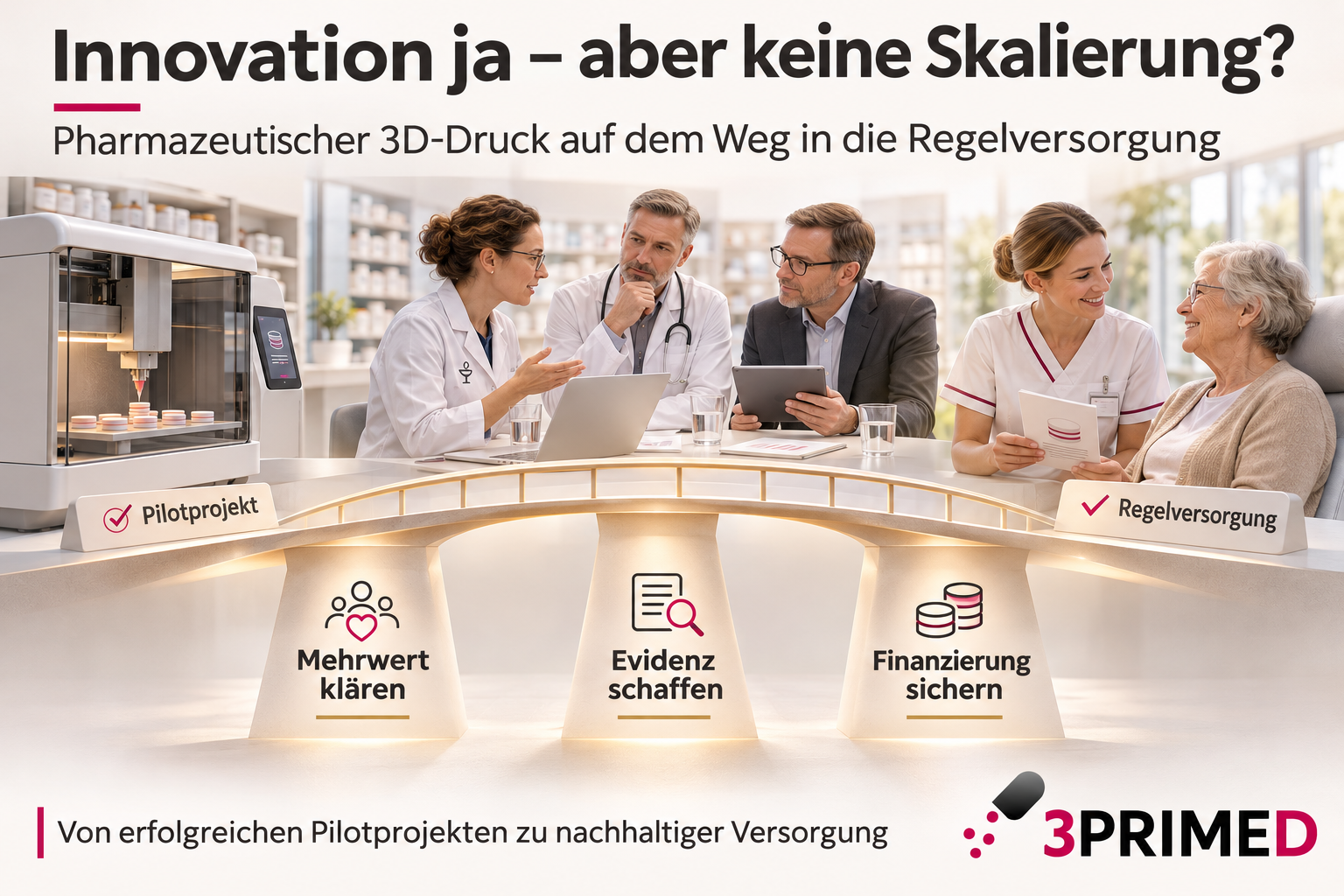
Was heute noch nach Zukunftsmusik klingt, steht morgen vielleicht schon im Klinikalltag: 3D- und 2D-Druck von Arzneimitteln.
Mit 3PRIMED – Conference on 3D & 2D Printed Medicines starten wir – Udo Sonnenberg und Patrick van Oirschot –
eine Plattform für genau diese Transformation.
💊 Worum geht es?
Personalisierte Arzneimittel, flexible Herstellungsprozesse und neue Versorgungsmodelle verändern die Rolle von Krankenhaus- und öffentlich und online Apotheken grundlegend. Technologien sind da – aber der Weg in die Regelversorgung ist alles andere als trivial.
❗ Die entscheidenden Fragen:
1. Wie integrieren wir individualisierte Medikamente in bestehende Gesundheitssysteme?
2. Welche regulatorischen und ökonomischen Rahmenbedingungen braucht es?
3. Wie wird aus technologischer Machbarkeit eine skalierbare Versorgung?
4. Und vielleicht die wichtigste Frage: Wer übernimmt Verantwortung?
🎯 Unser Ziel:
Wir bringen Entscheider:innen aus Krankenhausapotheken, Industrie, Regulierung und Gesundheitssystem zusammen – für einen offenen, ehrlichen und praxisnahen Dialog.
Keine Buzzwords.
Keine PowerPoint-Show ohne Substanz.
Sondern echte Diskussionen über das, was funktioniert – und das, was (noch) nicht funktioniert.
📍 Das erste 3PRIMED – Conference on 3D & 2D Printed Medicines Symposium findet am 1. Oktober 2026 in Berlin statt.
👉 Folgt dieser Seite, wenn ihr die Zukunft der pharmazeutischen Versorgung mitgestalten wollt.
👉 Kommt direkt auf uns zu, wenn ihr als Speaker, Partner oder Teilnehmer dabei sein möchtet.
Wir freuen uns auf den Austausch!
#3PRIMED #3DPrinting #2DPrinting #PersonalisedMedicine #Innovation #HealthcareTransformation #DigitalHealth

Read our blogs
Closed Loop Medication Management: From Vision to Reality
Why transforming medication management requires more than technology Closed Loop Medication Management (CLMM) has become an important ambition for hospitals seeking to improve medication safety, operational efficiency and the working environment of healthcare professionals. The vision is compelling: a digitally…
Warum eine Krankenhausapotheke in einem sich verändernden Umfeld nicht auf eine Strategie verzichten kann?
In einem sich verändernden Umfeld gibt es mehrere Gründe, warum ein Krankenhausapotheke nicht auf eine Strategie verzichten kann. Schauen wir uns einige dieser Gründe an: Innovation allein reicht nicht aus, um diese Herausforderungen zu bewältigen. Innovation ist zwar wichtig, um…
Asclepius: International Network of Closed Loop Medication Management Experts
Meet the visionaries promoting the transformation of medication management across Europe The Asclepius Project is an initiative dedicated to accelerate the transition from traditional manual and analog processes to innovative, digital, and automated medication management in hospitals across Europe. Our…
Follow on Linked-In
View profileRecommendations

Marc F.
Consultant-chercheur.
Patrick has huge abilities in change management, in project engeneering, and knows perfectly hospital and pharmacy environment. I really enjoyed to animate with him a masterclass for hospital pharmacists. He develops a high level of management knowledges and training capacities.
Endorsements
Function
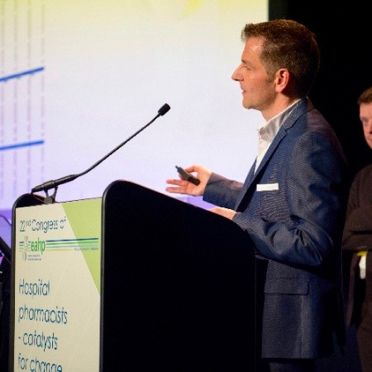
Speaker at the 2021 online EAHP congress – 3D medicines printing: adding an extra dimension to personalised precision medicine
There is a need for tailoring medicines according to a patient’s specific needs due to his/her genetic profile, phenotypic response, and pathophysiology. To enable the manufacturing of individualised oral medication in a scalable manner, new …
Recommendations
Bas Henrichs
Professional in Learning & Development en Innovatie Management.
I’ve met Patrick as an open minded straight forward man with a firm belief in making good relations work. Patrick is a serious, sympatric and empathic guy who knows his business and at the same time is a pleasure to hang around with.
Our clients
GPP Support’s partners have worked for hospitals and care institutions, extramurals, knowledge institutes and different types of industries.