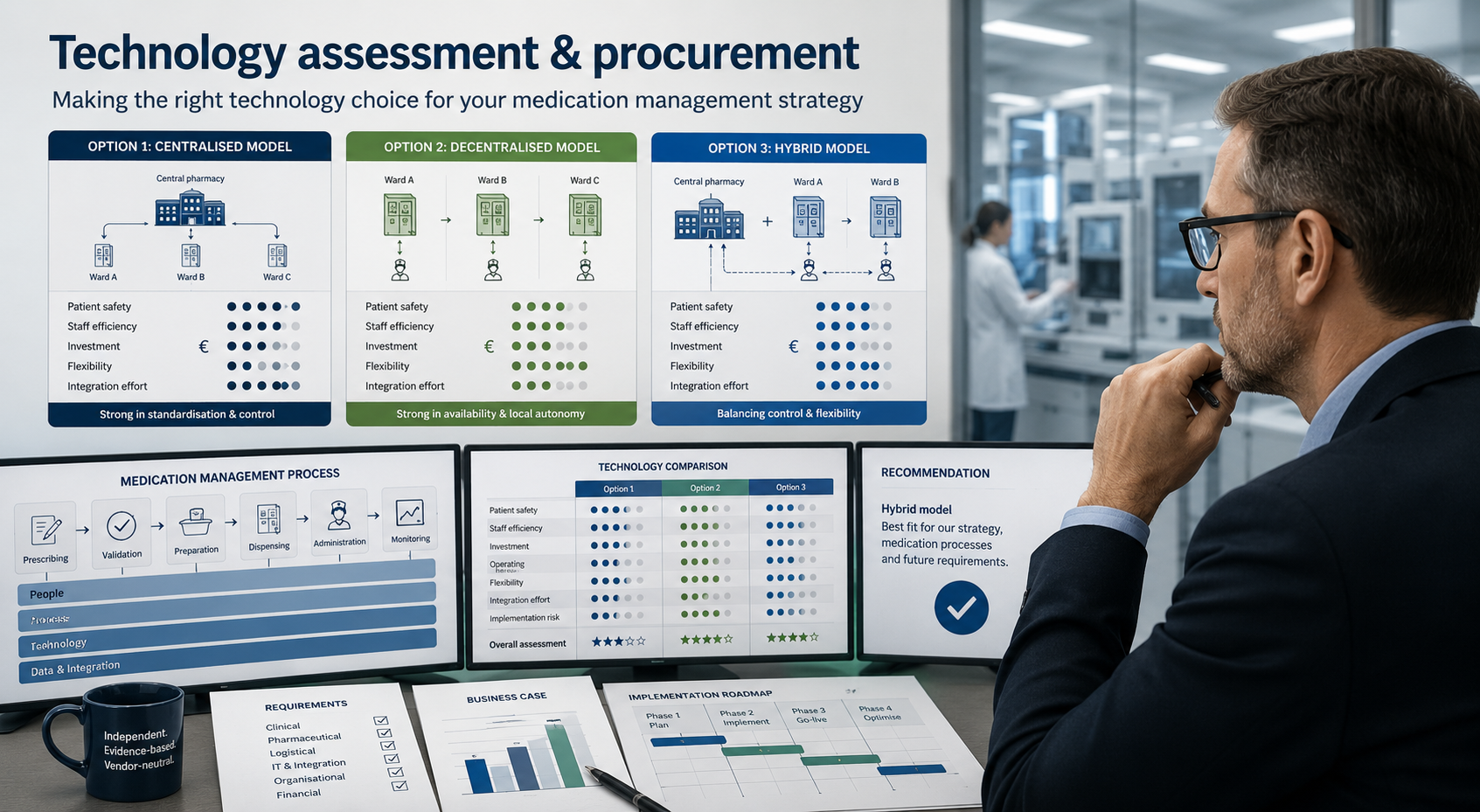
Making the value of hospital pharmacy innovation visible
Developing a hospital pharmacy business case requires looking beyond financial savings. Investments in automation, digitalisation and medication management also create value by improving medication safety, reducing workload, strengthening operational resilience and enabling healthcare professionals to focus on patient care.
Yet these benefits are not always easy to quantify. Investment costs are often visible and immediate, while the benefits may emerge over time, across different departments and budgets, or in forms that cannot directly be translated into financial savings.
GPP Support helps hospitals develop independent, evidence-based business cases that bring together financial, clinical, operational and strategic perspectives. We assess costs, benefits, risks and alternative scenarios to support transparent and well-informed investment decisions.
Our objective is not to justify a predetermined investment, but to establish whether, where and under which conditions an investment creates sustainable value.
Beyond the financial business case
A robust business case for hospital pharmacy innovation needs to capture more than financial returns. Investments in automation and digitalisation often create value across several dimensions, while costs and benefits may be distributed unevenly across the organisation.
GPP Support assesses investment value from four complementary perspectives:
- Financial value — capital expenditure, operating costs, maintenance, Total Cost of Ownership (TCO), return on investment (ROI), payback periods and financial sustainability.
- Clinical and patient safety value — reducing medication errors, improving traceability, strengthening medication safety and supporting reliable medication processes.
- Operational and workforce value — improving workflow efficiency, reducing repetitive tasks, increasing capacity and allowing pharmacy and nursing staff to focus on activities that require their professional expertise.
- Strategic and organisational value — supporting future operating models, scalability, interoperability, organisational resilience and long-term transformation.
Not every benefit can or should be expressed in monetary terms. Where reliable evidence is available, we quantify financial and operational effects. Other benefits are assessed through measurable performance indicators, qualitative evidence and transparent assumptions.
This creates a balanced assessment of investment value, helping decision-makers understand not only what an investment costs, but also what it contributes to the hospital and its patients.
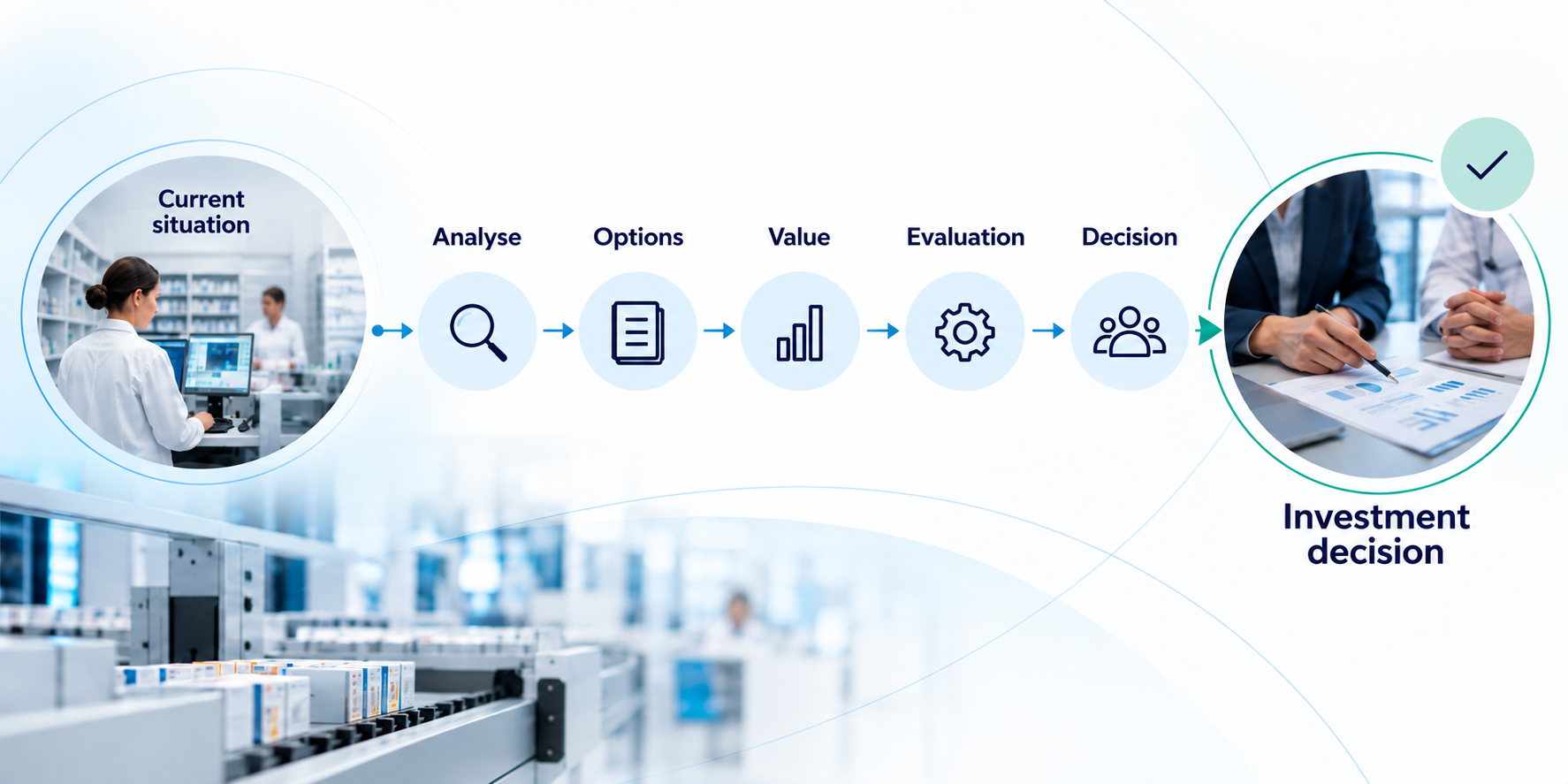
Our approach to hospital pharmacy business case development
A credible business case starts with understanding the current situation, the challenges to be addressed and the objectives of the proposed investment. It should provide a transparent basis for decision-making, rather than simply demonstrate that a preferred solution is financially attractive.
GPP Support develops tailored business cases through a structured, evidence-based approach, combining hospital pharmacy expertise with financial analysis and practical implementation experience.
Our approach typically includes:
- Baseline and current-state assessment — analysing existing medication processes, activity volumes, staffing, costs, performance and operational challenges.
- Objectives and alternative scenarios — defining the intended improvements and comparing different organisational, technological and investment options, including the option of maintaining or optimising existing processes.
- Cost and investment modelling — assessing capital expenditure, implementation costs, operating expenses, maintenance, infrastructure and lifecycle costs.
- Benefits and value assessment — identifying and, where possible, quantifying financial, clinical, operational and workforce-related benefits.
- Financial evaluation — calculating relevant indicators such as Total Cost of Ownership (TCO), Return on Investment (ROI), payback periods and, where appropriate, Net Present Value (NPV).
- Risk and sensitivity analysis — examining how changes in assumptions, implementation timelines, operational performance and expected benefits affect the outcome.
- Decision support and recommendations — presenting findings, trade-offs and recommendations in a format that supports transparent discussion and informed investment decisions.
Throughout the process, we work closely with hospital pharmacy, clinical departments, finance, IT and hospital management to ensure that assumptions are realistic and that the business case reflects the organisation’s actual circumstances.
The result is a decision-making instrument that can also serve as a baseline for monitoring whether the expected benefits are realised during and after implementation.
From costs to value
One of the challenges in developing business cases for hospital pharmacy innovation is that the department making the investment is not necessarily the department receiving the benefits.
For example, investments in centralised Unit Dose dispensing or Automated Dispensing Cabinets may require substantial expenditure within hospital pharmacy, while important benefits emerge on nursing wards through reduced medication preparation time, improved availability and safer medication administration.
Similarly, digital integration and Closed Loop Medication Management may improve traceability, reduce medication errors and strengthen clinical processes without generating immediate or directly measurable financial savings.
GPP Support helps hospitals understand these interdependencies and assess value across departmental and organisational boundaries.
This includes distinguishing between:
- Direct financial savings — measurable reductions in expenditure, such as lower inventory costs, reduced waste or avoided external costs.
- Capacity and productivity gains — time released through automation and process improvement, which may increase capacity or reduce workload without necessarily reducing staffing costs.
- Quality and patient safety improvements — fewer medication errors, improved traceability and more reliable processes, assessed using appropriate clinical and operational indicators.
- Avoided future costs — investments that help prevent additional staffing requirements, capacity constraints or operational inefficiencies as demand increases.
- Long-term strategic benefits — greater flexibility, resilience and the ability to adapt to changing healthcare requirements.
A credible business case makes these different forms of value explicit. It avoids treating every efficiency gain as a cash saving and distinguishes between benefits that can be financially realised and those that create broader organisational or clinical value.
The objective is to make the full value of an investment visible, without overstating its financial return.
Supporting investment decisions
A business case only creates value when it helps decision-makers understand their options and make informed choices. Financial calculations are important, but they need to be translated into clear recommendations that reflect the hospital’s strategic priorities, operational realities and available resources.
GPP Support supports hospital pharmacists, executive management, finance departments and other stakeholders in evaluating investment proposals and building a shared understanding of their implications.
Depending on the assignment, our support includes:
- Investment scenarios and decision options — comparing alternative solutions, implementation strategies and investment timelines.
- Executive-level investment proposals — translating complex financial, technical and operational analyses into clear recommendations for hospital boards and investment committees.
- Stakeholder alignment — bringing together hospital pharmacy, nursing, medical staff, IT, finance and management to discuss assumptions, priorities and expected benefits.
- Funding and financial feasibility — assessing available budgets, investment constraints and relevant funding mechanisms.
- Implementation and benefits realisation planning — defining responsibilities, milestones and performance indicators to monitor whether the expected value is achieved.
Our role is to provide independent analysis, challenge assumptions and make the consequences of different choices transparent.
The outcome is not simply a financial model, but a well-founded investment proposal that connects strategic ambition with practical and financially sustainable implementation.
Selected project experience
GPP Support has supported hospitals across Europe in evaluating the financial, operational and strategic value of investments in hospital pharmacy automation, digitalisation and medication management.
Our experience includes business case development, investment assessments, scenario comparisons and decision support for hospital pharmacy transformation.
University hospital, Germany
Investment assessment and scenario analysis for central pharmacy automation and Unit Dose dispensing, considering technology alternatives, operational capacity, investment requirements and future medication distribution processes.
Hospital group, Germany
Evaluation of centralised, decentralised and hybrid medication-management models, including technology requirements, organisational implications and investment considerations across multiple hospital sites.
European hospital projects
Business case and ROI assessments for medication management technologies, including Unit Dose systems, Automated Dispensing Cabinets and integrated pharmacy automation. These assessments help hospitals compare investment options, understand potential benefits and identify the conditions for sustainable implementation.
Discuss your business case
Considering an investment in hospital pharmacy automation, digitalisation or Closed Loop Medication Management? Or struggling to demonstrate the value of a proposed transformation?
Whether you are a hospital pharmacist, hospital executive or finance professional, GPP Support can help you develop a credible business case that brings together financial, clinical, operational and strategic perspectives.
Let’s explore your investment challenge and identify what is needed to make a well-informed decision.